Central Ohio’s four health systems – Mount Carmel Health System, Nationwide Children’s Hospital, The Ohio State University Wexner Medical Center and OhioHealth – are planning and investing now to maintain access to high-quality care, modernize how care is delivered and make sure the region has the people, technology and capacity needed for the years ahead. That investment includes much more than new buildings. It means preparing for a larger population, more older adults and patients who increasingly need complex care.
Health system growth is essential infrastructure for a growing region.
Explore this page:
Explore a summary document:
Health systems have to plan for the community Central Ohio is becoming, not only the needs that exist today. Population growth, an aging population and changes in the care hospitalized patients require are increasing both the amount and types of care the region needs.
More people including more older adults, will need care across a wide range of settings. Preparing for that demand helps preserve access as the region grows.
According to MORPC, by 2025, the 15-county Central Ohio region will see a 31% increase in population from 2.6 million to 3.15 million.
By 2050, approximately 320,000 Franklin County residents are projected to be 65 or older, a 62% increase over 2025. (Miami University) As we age, our health care needs often become more complex, requiring special, more intensive care. Over the last 10 years, our hospitals have seen a 7.5% increase in case mix index, which measures clinical complexity, illness severity, and resource needs of patients. (Ohio Hospital Association)
The number of patients is only part of the story. Hospitalized patients are also staying longer and requiring more intensive care. From 2015 to 2025, inpatient use among adults aged 65 and older increased by 22%, while the average hospital stay increased by approximately 14%. (Ohio Hospital Association)
Hospitals are caring for patients who often need more intensive treatment, specialized services, technology and clinical resources. That puts additional pressure on beds, care teams and other hospital capacity.
Major health care investments cannot be developed overnight. Facilities, technology and new approaches to care can take years to plan and implement. Major developments can take up to 15 years from early planning and land acquisition to opening. Planning ahead means preparing before existing capacity is strained.
When people hear “health system growth,” they may picture cranes, construction and new hospital towers. But the infrastructure needed to care for a growing region is much broader.
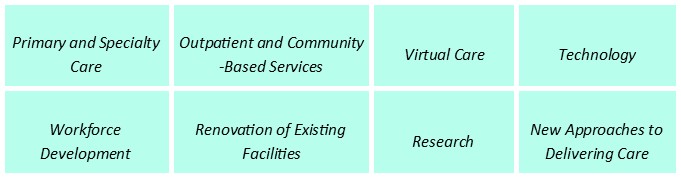
Health system investment includes the places where care happens, the people who provide it, the technology that supports it and new ways of bringing appropriate care closer to patients.
Health care infrastructure matters because of what it makes possible for patients, families and the region as a whole.
As more people call Central Ohio home, investment across primary, specialty, outpatient, emergency and hospital care helps the region keep pace with demand and reduce delays.
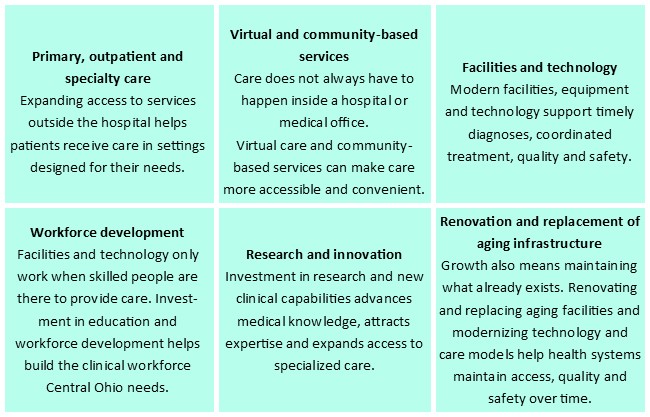
Not every health need requires a hospital. Expanding different types of care gives patients more opportunities to receive services in a setting designed for what they need, whether that is a physician’s office, an outpatient center, a community location, virtual care or a hospital.
When patients can receive appropriate care outside the hospital, emergency and inpatient resources can remain available for people who need hospital-level treatment. Shared hospital data demonstrated significant demand for behavioral health care in local emergency departments.
Reliable access to high-quality health care is part of the infrastructure employers, employees and families depend on. Health systems are also major regional employers themselves. Franklin County hospitals employ more than 60,000 people, with combined payroll expenses exceeding $3.6 billion, and hospital activity sustains one out of every nine jobs in Central Ohio. (COHC)
Investment in research, innovation, clinical programs and specialized capabilities can help Central Ohio attract health care talent, advance medical knowledge and allow more residents to receive advanced care close to home.
Because health care infrastructure takes time to plan and build. Central Ohio is projected to continue growing and aging, while hospitalized patients increasingly need complex care. Facilities, technology, workforce and new models of care can take years to develop, so health systems have to prepare before additional capacity becomes urgently needed.
New construction is only one form of investment. Growth also includes:
Hospital expansion and new construction are not driving higher healthcare prices. While affordability remains a significant challenge in Central Ohio, rising healthcare costs are primarily influenced by factors such as inflation, higher supply and labor costs, workforce shortages, and the increasing complexity of caring for patients with serious medical needs. Health systems finance expansion through a variety of sources, including operating revenue, bond financing, and philanthropy. As not-for-profit health systems, we fund our growth through operating revenue that is reinvested back into our mission of improving the health of those we serve.
The broader goal is to maintain access to appropriate, high-quality care as community needs and ways of delivering care change. That does not mean every service will always remain in the same location or be delivered in the same way. The facts behind any individual closure, relocation or service change should be considered separately. At the regional level, access means helping patients receive care in the setting best equipped to meet their needs.
Major investments are evaluated over many years and reviewed against projected community needs, organizational priorities and available resources. Governing boards that include community and business leaders provide oversight of major capital decisions.
Central Ohio’s four health systems are separate not-for-profit organizations, but they share important responsibilities to the communities they serve.
Not-for-profit hospitals do not distribute profits to shareholders. Resources are instead reinvested in patient care, facilities, technology, workforce development, research, education, innovation and community services. In 2024, Franklin County’s not-for-profit hospitals provided more than $1.14 billion in community benefit, including unreimbursed care for uninsured and Medicaid patients, health education, research and community-based services. (COHC)
Central Ohio does not have a traditional public safety-net hospital. Therefore, the four systems share responsibility for providing medically necessary hospital care regardless of a patient’s ability to pay and collaborate through a shared charity-care policy for free and discounted hospital care.
Some community challenges require a regional response. The four systems can combine information, expertise, resources and partnerships to address needs that would be difficult for one organization to solve alone. Their work with community partners to advance the Franklin County Crisis Care Center is one example of that shared approach.
Central Ohio will continue to change. Its health care infrastructure has to be ready to change with it.
Continued investment helps preserve access, prepare for future needs and make sure people throughout the region can receive high-quality care in the setting best equipped to provide it.
Health system growth is essential infrastructure for a growing region.